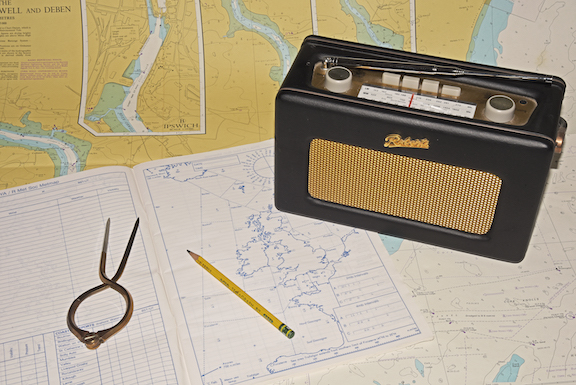

The last Shipping Forecast from BBC radio on Long Wave went out at 0048 on Saturday June 27 2026, bringing to an end a 101 year tradition that has been a lifeline to mariners since 1925, writes Dan Houston.
Unlike FM, DAB, Wi-Fi or VHF broadcasts the Shipping Forecast on Long Wave was a free service that you could tune into on 198kHz when you were hundreds of miles offshore. And you could be using a simple battery-operated radio that cost just a few pounds.
The Shipping Forecast covers all the sea areas around Britain and Ireland – from Iceland across to Norway, the North Sea, Channel, Western approaches and as far south as Cape Trafalgar.
The forecast carries a mix of information – beginning with any gale warnings over the whole area, before the General Synopsis – of the pressure systems’ positions, values (in millibars) and expected movement over the following 24 hours. It then delivers the 24hr outlooks for each of the 31 sea areas giving: Wind: Direction and speed (in Beaufort Scale). Weather: Expected precipitation (rain, showers or fog), Visibility and Sea State.
Should we be concerned by this move? The loss of Long Wave radically reduces the reach of the forecast which has been a staple of many mariners’ lives from the days or their great grandfathers. The important thing to remember is that the weather can change. Relying on a forecast on your phone, like Windy, is great if you are going out for the day. But once you are out of sight of land your phone will be out of signal range and you won’t be able to keep up with the changes in the weather. Of course other systems are available… and we’ll get to them.
There have been motions to keep BBC Long Wave, and as late as April 2026 23 members of parliament supported an Early Day Motion questioning its closure, backed by a 7,000 signature petition. It is difficult to find statistics on how many people were listening to the Shipping Forecast or relying on it. But the wider loss of Long Wave is already being felt in areas of Britain which do not receive FM or DAB broadcasts. Those living in remote valleys from Devon to Scotland have often relied on LW which can rattle its way into those places – which are otherwise radio “blindspots”. It will also be affecting those living in countries like France. The 150 watt output of the main BBC LW transmitter has ensured the signal could be heard loud and clear in places like Santander and southern Norway – just two places I can cite from personal experience.
The BBC has been running several programmes on both the Medium Wave and Long Wave (MW/LW). It had to do this because FM, or VHF, is basically a line-of-sight medium, restricted by the curvature of the earth. That’s why the best place for your VHF aerial is at the top of your mast. An important distinction between MW and LW (Medium and Long Wave) versus FM (Frequency modulated) is that the former are amplitude modulated (AM) radio waves which propagate across the surface of a territory, with a range of hundreds of miles – depending on the strength and efficiency of the signal frequency. So remote glens and sea lochs of Scotland are a good example where LW signals will reach the most obscure locations. Long Wave, with frequencies in Europe between 148.5 and 283.5kHz and wavelengths over 1,000m (R4’s is 198kHz and 1514m respectively), remains a very efficient carrier of information in terms of both cost and reach.
The Long Wave also travels better over water, and an area of sandstone or well drained land will impede the signal more than if the ground is of clay say.
All this means that if you were anchored in an out of the way bay in many parts of these islands as well as our European and Scandinavian neighbours the Shipping Forecast on LW was often the best and definitely the cheapest way you could get a detailed idea of the coming weather.
Alternatives.
Of course one of the reasons the BBC could remove its support for Long Wave is because fewer and fewer people have been using it. The old Shipping Forecast was superseded by online offerings from the mid 1990s, and coastal sailors lost the habit of tuning in to the radio for their weather. From at-a-glance synoptic charts giving you the graphic weather information through barometric lines and well-defined frontal systems, to the interactive sites like PredictWind or Windy, the old business of listening to the R4 announcer and taking down details in some form of shorthand, became irrelevant unless you were over the horizon or anchored in a remote bay.
Navtex sets use the Long Wave for the same reason and the forecasts and safety information are free and fairly frequent, though sets-and-aerials themselves begin at around £300. The system was developed and tested in the 1970s and typically has a small screen of information for you to scroll through.
Starlink is probably the next best solution, though more suitable for liveaboards and long cruises with its monthly subscription packages. These are getting more affordable and in January 2026 Starlink for cruisers wanting high speed internet at sea, doubled the data consumption for its Roam Unlimited users from 50Gb to 100Gb per month on the £50/$50USD plan – with its Mini dish (consuming 20–40 watts (1.5–3.5amps/hr at 12V) during normal operation, typically retailing for under £250.
Cruising in the arctic some years ago we used a mini sat phone, mostly for weather and these remain a good option for use offshore though the cost is still around £300, though monthly hire can be as low as £15. There are per-minute charges and weather forecasts can be £1 a pop say.
AIS is also set to develop with more features – including real time weather at sea, see our story:
Some history:
1854: Robert Fitzroy, captain of HMS Beagle when Charles Darwin was aboard, becomes Meteorological Statist to the Board of Trade. He introduces his specially designed fishery barometers to seaports around Britain and begins collecting weather data. This is the forerunner of the Met Office and Fitzroy had three staff.
1859: the immigrant steam clipper ship Royal Clipper sinks in a F12 storm off the coast of Anglesey, Wales, on October 26, with the loss of 459 lives. Fitzroy develops weather charts and the following year introduces a storm warnings system of cones and balls to be hoisted in ports, with orders to stop fishing fleets leaving. Fitzroy became a hero to fishermen but fishing fleet owners forced the system to be abandoned after his death in 1865. However the system was reintroduced in 1874.
1861: As head of the Meteorological Office Captain Fitzroy introduced the first British centralised storm warning service for shipping, making use of the electric telegraph. He saw the Met office’s job as being primarily to save lives at sea.
1911: The Met Office began issuing marine weather forecasts including gale and storm warnings via radio transmission in Morse code for sea areas around Great Britain.
1925: The newly founded BBC took over the Shipping Forecast as a voice service, on Long Wave known as The morning weather forecast for Farming and Shipping”. This then became the more specific Weather Shipping in October that year.
1926: In January an evening forecast is added giving better coverage of the weather trends.
1939: The forecast was suspended at the outbreak of the Second World War. Coded versions via civil defence networks were broadcast to ships and military personnel.
1945: BBC resumes the Shipping Forecast on the Home Service on July 29.
1956: 22 April the Shipping Forecast moves to the Light Programme on 200kHz (1500m)
1963: ‘Sailing By’ by Ronald Binge was chosen by the BBC as the musical interlude to be played every night before the Shipping Forecast.
1978: In November BBC Radio 4 took over the 1500m (200 kHz) long-wave frequency from BBC Radio 2 (which had been the Light Programme). The frequency was subsequently shifted, a smidgeon to the left, to 198 kHz in 1988 as part of international agreements to harmonize the spectrum. In practice this meant all frequencies had to be divisible by nine cutting down the risk of interference with neighbouring frequencies, and therefore creating clearer signal.
1995: The Shipping Forecast goes digital on air as the BBC launches Digital Audio Broadcasts from five transmitters around London, for the first time on September 27.
2002: British Shipping Forecast sea area Finisterre is changed to Fitzroy in memory of Admiral Fitzroy (1805 – 1865).
2024: 31 March the four broadcasts a day on LW become two, with three at weekends.
2026: June 27: Last broadcast of the shipping forecast on 198kHz R4 as the BBC’s Long Wave output closes down.